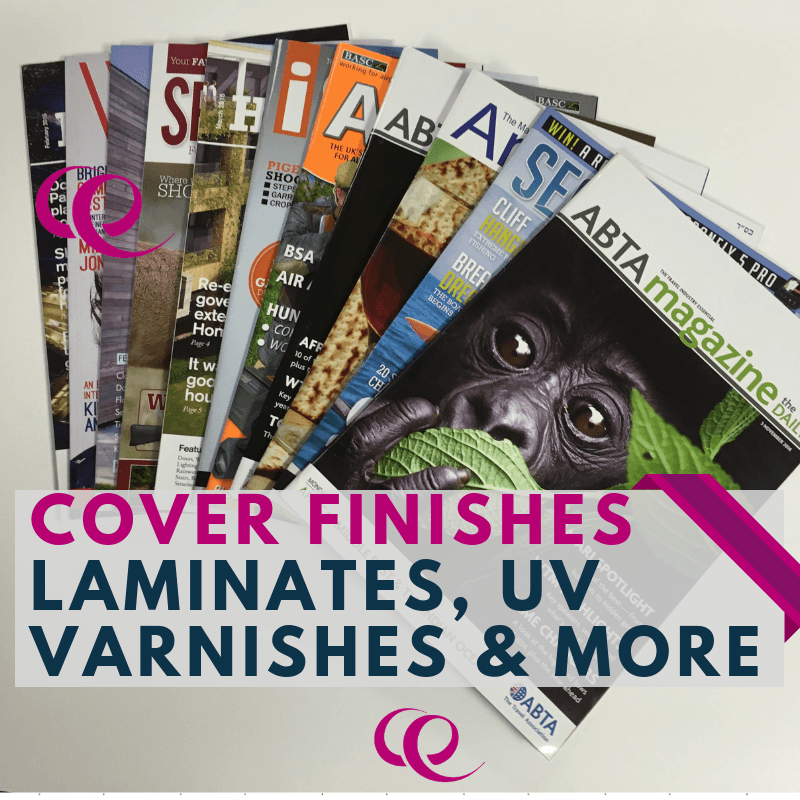
Cover finishes – laminates, UV varnishes for magazine, brochure and catalogue printing
Print finishing can change the appearance, feel, durability and cost of a brochure, catalogue, prospectus or other printed product.
But adding more finishing does not automatically produce better print.
The right finish depends on what the printed piece needs to achieve, how it will be handled, the paper or board, the artwork, quantity, production method, budget and required appearance.
Lamination may be used primarily for protection and surface feel. Spot UV can create contrast between selected design elements and the surrounding surface. Foiling can introduce metallic, coloured or specialist detail. Embossing and debossing physically alter the surface to create a tactile effect.
These techniques can also be combined.
As an independent print-management company, Cliffe Enterprise can consider finishing as part of the complete print specification rather than automatically applying a standard treatment.
What Is Print Finishing?
Print finishing describes processes carried out during or after printing that alter the final construction, surface, appearance or functionality of the product.
Depending on the job, finishing can include:
- lamination;
- varnishing;
- spot UV;
- foiling;
- embossing and debossing;
- die cutting;
- creasing and folding;
- binding;
- drilling;
- perforating; and
- other specialist processes.
This guide concentrates principally on decorative and protective surface finishes.
Binding, folding and other structural operations are also finishing processes, but they serve a different production purpose.
Which Print Finish Should You Choose?
There is no single best finish.
A useful starting point is to decide what you are trying to achieve.
| Requirement | Finishes commonly considered |
|---|---|
| Protect a frequently handled cover | Lamination or suitable coating |
| Create a low-sheen premium surface | Matt or soft-touch lamination |
| Create a glossy surface | Gloss lamination or suitable varnish |
| Highlight selected artwork | Spot UV |
| Add metallic or coloured detail | Foiling |
| Create raised physical texture | Embossing |
| Create recessed physical texture | Debossing |
| Create a custom shape or aperture | Die cutting |
| Combine tactile and visual contrast | Lamination + spot UV, foil + embossing or other combinations |
These are starting points rather than rules.
The suitability of a finish depends on the paper, design, quantity and manufacturing route.
What Is Lamination?
Lamination applies a thin film to the printed surface.
It can alter both the appearance and feel of the product while also providing additional protection against handling, marking and moisture.
Lamination is frequently used on:
- brochure covers;
- catalogue covers;
- prospectuses;
- presentation folders;
- menus;
- book covers;
- cards; and
- other frequently handled printed products.
The most appropriate film depends on the required appearance, durability and subsequent finishing processes.
Matt Lamination
Matt lamination creates a relatively low-sheen surface.
It can produce an understated appearance and is widely used for corporate and premium marketing material.
Matt lamination can also provide an effective background for contrasting finishes such as gloss spot UV.
However, the interaction between a laminate, dark solid colours and handling should be considered carefully because some surfaces can show marking or fingerprints more readily than others.
Physical samples are useful where the finished appearance is important.
Gloss Lamination
Gloss lamination creates a reflective surface and can increase the visual contrast of printed imagery.
It can work particularly well where strong photographic impact or a highly polished appearance is required.
The higher reflectance may be less appropriate where extensive text needs to be read comfortably under varied lighting conditions.
As with any finish, the choice should follow the purpose of the product rather than simply a preference for gloss or matt.
Soft-Touch Lamination
Soft-touch lamination creates a distinctive tactile surface often described as smooth or velvety.
It is commonly considered for premium brochures, prospectuses, presentation material and other products where the feel of the printed piece forms part of the intended impression.
Soft-touch can also provide a contrasting background for spot UV or foiled details.
It should not automatically be specified simply because a product is intended to feel premium.
Paper, artwork, handling, cost and the required durability should all be considered.
What Is Print Varnish?
A varnish is a coating applied to the printed surface.
Depending on the process and formulation, varnishes can provide protection, alter surface appearance or create visual contrast.
Varnish may be applied across the complete surface or selectively.
Different printing and finishing technologies use different types of coating, so terms such as varnish, UV coating and aqueous coating should not be treated as interchangeable.
The appropriate solution depends on the printing process, substrate and required result.
What Is Spot UV?
Spot UV applies a UV-cured coating to selected areas rather than necessarily covering the complete printed surface.
A gloss spot UV can be used to highlight:
- logos;
- headings;
- photographs;
- patterns;
- illustrations; or
- other design elements.
The contrast is often particularly noticeable when a gloss spot UV is applied against a matt or soft-touch background.
This creates both visual and tactile differentiation without changing every part of the design.
Is Spot UV the Same as Lamination?
No.
Lamination generally applies a film across the surface of the printed piece.
Spot UV applies a coating to selected areas.
They can be used together.
For example, a brochure cover might use matt or soft-touch lamination across the complete cover with gloss spot UV applied selectively over a logo or image.
The artwork and manufacturing sequence need to be planned for the combination.
Raised and Textured UV Effects
Some specialist digital and screen processes can create raised or textured clear effects.
These provide more physical depth than conventional flat spot varnish.
They can be used to emphasise typography, patterns or selected graphic elements.
The suitability depends on the design, substrate, quantity, available technology and required effect.
A physical sample is particularly useful for tactile finishes because photographs and screens cannot accurately communicate how the finished piece feels.
What Is Foiling?
Foiling applies a coloured, metallic, holographic or other specialist foil to selected areas of the printed product.
Traditional hot-foil blocking uses a heated die to transfer the foil to the substrate.
Foiling is frequently used for:
- logos;
- titles;
- borders;
- premium branding;
- certificates;
- invitations;
- brochure covers;
- presentation folders; and
- packaging.
Gold and silver are familiar examples, but many other colours and effects are available.
Hot Foil vs Digital Foil
Traditional hot foiling generally requires tooling such as a die.
This creates setup cost but can produce extremely crisp and distinctive results across suitable quantities and substrates.
Digital foiling can avoid some traditional tooling requirements and may therefore be attractive for shorter quantities, versioned work or applications suited to the technology.
Neither process is universally better.
The decision depends on quantity, substrate, artwork, required effect and production economics.
What Is Embossing?
Embossing physically raises a selected part of the paper or board.
It can be used for:
- logos;
- lettering;
- patterns;
- borders; and
- other graphic elements.
Because the paper itself is formed, embossing creates a genuine three-dimensional tactile effect rather than simply adding another printed colour or coating.
The result depends considerably on the paper or board.
Stock thickness, stiffness, surface and construction can all influence the depth and definition that can be achieved.
What Is Debossing?
Debossing creates a recessed impression rather than a raised one.
It can produce a restrained tactile effect and can work particularly well on suitable heavier or tactile papers and boards.
Embossing and debossing can sometimes be used without additional colour or foil.
This is often called a blind emboss or blind deboss.
Can Foiling and Embossing Be Combined?
Yes.
Foiling and embossing can be combined so that a foiled area also has physical depth.
This can create a strong premium effect, particularly for logos, titles and selected design elements.
Accurate artwork, tooling and registration become particularly important when processes are combined.
The manufacturing route should therefore be established before the artwork is finalised.
What Is Die Cutting?
Die cutting creates shapes, windows, apertures or non-standard edges in printed paper or board.
It can be used for:
- presentation folders;
- brochure covers;
- direct mail;
- packaging;
- promotional pieces;
- tabs;
- apertures; and
- unusual finished shapes.
Traditional die cutting generally requires tooling.
Digital cutting can be useful for some shorter-run or prototype applications.
As with foiling, the most appropriate method depends on quantity, material, complexity and required finish.
Can Several Print Finishes Be Combined?
Yes, but more finishing does not automatically mean a better result.
Examples can include:
- matt lamination with gloss spot UV;
- soft-touch lamination with foil;
- foil with embossing;
- lamination with die cutting;
- embossing on an uncoated premium stock; or
- combinations of several specialist processes.
The most effective finishing often comes from contrast and restraint.
One well-chosen finish that supports the artwork can have more impact than several competing effects.
How Does Paper Affect Print Finishing?
Paper and finishing should be specified together.
The surface, coating, thickness, stiffness and construction of the stock can all influence the result.
For example:
- embossing needs a stock capable of accepting the required impression;
- some highly textured papers can affect very fine foiling;
- spot coatings may behave differently on absorbent and coated surfaces;
- folding a heavy or laminated stock may require appropriate creasing;
- certain finishes can alter the appearance of printed colour.
This is why finishing should ideally be considered before the paper and artwork specification are completely fixed.
Do Print Finishes Affect Binding?
They can.
Lamination, coatings, paper thickness and cover construction can influence subsequent folding, creasing and binding.
For perfect- and PUR-bound publications, the cover needs to wrap accurately around the text section and spine.
For saddle-stitched work, heavy covers may need to fold around nested pages.
The complete sequence — printing, finishing, folding and binding — should therefore be considered as one manufacturing process.
How Do Print Finishes Affect Cost?
Finishing adds manufacturing stages, and some processes require tooling or additional setup.
Cost can therefore be affected by:
- quantity;
- finished size;
- number of finished areas;
- tooling;
- substrate;
- artwork complexity;
- registration requirements;
- number of processes;
- production method; and
- schedule.
A finish that is economical across a substantial quantity may be relatively expensive for a very short run if significant tooling is required.
Alternative digital finishing technologies may sometimes change that calculation.
The right comparison is therefore the complete finished cost, not simply the price of an individual finishing operation.
Do Print Finishes Affect Lead Time?
Potentially.
Every additional manufacturing process needs to fit into the production sequence.
Specialist foiling, embossing, die cutting, lamination or coatings may require separate equipment, tooling or specialist finishing capacity.
For time-critical work, finishing should therefore be specified at the beginning rather than added immediately before production.
Cliffe can consider finishing requirements when selecting the overall production route and manufacturing partner.
Artwork for Spot UV, Foil and Other Finishes
Specialist finishes often require artwork elements to be supplied separately from the normal printed design.
For example, the areas intended for spot UV, foil, embossing or die cutting may require clearly defined vectors, masks or cutting paths.
Exact artwork requirements depend on the production method and supplier.
Do not assume that an effect shown visually in the design file is sufficient manufacturing information.
The finishing method should be agreed first and the artwork prepared to the requirements of the selected production route.
Should You Ask for a Finishing Sample?
Where appearance or tactility is important, yes.
A screen cannot accurately demonstrate:
- the feel of soft-touch lamination;
- the depth of embossing;
- the reflectance of foil;
- the contrast of spot UV; or
- how a particular finish interacts with a chosen paper.
A relevant physical sample can therefore be more useful than trying to make a finishing decision from photographs alone.
For particularly important or unusual requirements, a production proof or prototype may also be appropriate depending on the process.
Print Finishing and Sustainability
Finishing can affect the material composition and recyclability of a printed product.
The impact depends on the paper, film, coating, adhesive, foil and manufacturing process used.
If recyclability or a particular environmental requirement is important, establish that requirement before specifying the finish.
Avoid assuming that all laminates, varnishes, foils or specialist effects have identical environmental characteristics.
The most appropriate solution depends on the actual materials and processes being considered.
How Cliffe Selects Print Finishing
Cliffe Enterprise is an independent print-management company.
We do not begin with a particular finishing machine or process that needs to be sold.
We begin with the requirement.
That means considering:
- what the printed piece needs to achieve;
- intended lifespan;
- paper or board;
- artwork;
- quantity;
- printing process;
- binding;
- handling;
- distribution;
- schedule;
- environmental requirements; and
- budget.
We can then select an appropriate manufacturing and finishing route.
Sometimes a premium finish materially improves the finished product.
Sometimes it adds cost without adding useful value.
The objective is to specify the finish because it supports the product — not simply because the process is available.
Print Finishing FAQs
What is the best finish for a brochure cover?
There is no universal best finish.
Matt, gloss or soft-touch lamination, spot UV, foiling and embossing can all be appropriate depending on the paper, artwork, audience, handling and budget.
What is the difference between spot UV and lamination?
Lamination generally applies a film across the printed surface, while spot UV selectively applies a UV-cured coating to particular areas.
The two processes can also be combined.
Is soft-touch lamination better than matt lamination?
Not inherently.
Soft-touch provides a distinctive tactile feel, while conventional matt lamination may be preferable where that texture is unnecessary.
The correct choice depends on the intended product and budget.
Can you put spot UV over lamination?
Yes, certain combinations are commonly used.
Gloss spot UV over a matt or soft-touch surface can create strong visual contrast.
The compatibility of the specific materials and process should be confirmed before production.
Can foil be used on uncoated paper?
Yes, depending on the paper and foiling process.
Texture and surface characteristics can affect the detail and appearance, so physical samples or testing may be useful.
What is the difference between embossing and debossing?
Embossing raises the selected area.
Debossing creates a recessed impression.
Both physically alter the surface of the paper or board.
Can foil and embossing be combined?
Yes.
Foil and embossing can be registered together to create a reflective finish with physical depth.
Does finishing make print more expensive?
Usually, because additional processes, setup or tooling are required.
The amount depends on quantity, process, material, complexity and production route.
Does print finishing increase lead time?
It can.
Additional manufacturing operations and specialist tooling or equipment can extend the production sequence, so finishing should be planned early for deadline-critical work.
Can Cliffe advise which finish to use?
Yes.
If you provide the product, quantity, paper, artwork, binding, intended use and budget, we can assess finishing as part of the complete production specification.
Need Help Choosing a Print Finish?
If you already know the finish you require, send us the complete print specification and we can assess the appropriate manufacturing route.
If you’re deciding between lamination, spot UV, foiling, embossing or another finish, involve us before the artwork and paper specification are completely fixed.
That gives us the opportunity to consider printing, paper, finishing, binding, cost and schedule together.
I HAVE A SPECIFICATION — REQUEST A QUOTE
I NEED ADVICE — TALK TO CLIFFE ABOUT MY FINISHING REQUIREMENT